You might have been here before
If you've ever done a strengths assessment - CliftonStrengths, perhaps, or something similar at a team away-day - you already have a rough sense of the territory. You answer a series of questions, you get a report, and somewhere in it you find a description of yourself that's a little uncomfortably accurate.
Strengthscope works in similar territory. But it asks a slightly different question - and that difference matters more than it might first appear.
What Strengthscope actually measures
Most strengths tools ask what you're good at. Strengthscope asks what energises you.
That shift sounds small. It isn't. Because most of us are capable of doing things we find quietly draining - and we can do them competently, even well, for years - without ever noticing the slow leak. We've learned to perform. We've gotten good at things that don't particularly light us up. And after a while, we can lose track of the distinction between what we're capable of and what actually gives us energy.
Strengthscope is interested in the latter. The things that leave you feeling more alive when you do them, not less. The tasks and interactions that you'd gravitate toward even if nobody was watching.
How it works
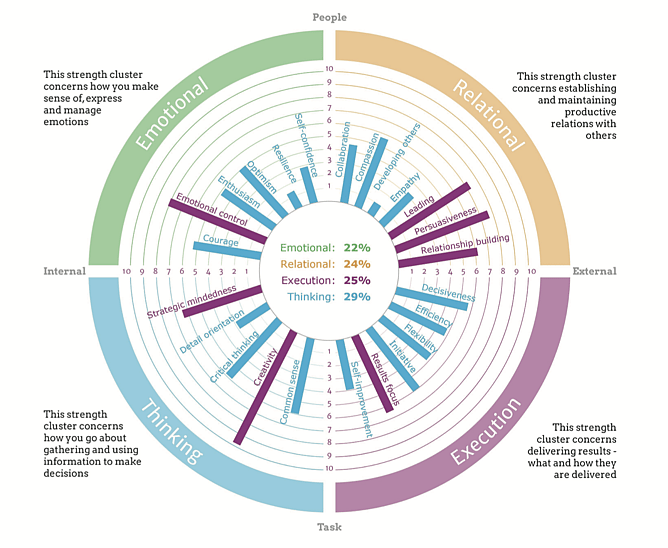
You complete an online questionnaire - it takes around twenty minutes - and what comes back is a picture of your strengths across 24 dimensions, grouped into four broad clusters: Emotional, Relational, Thinking, and Execution. You can see what that looks like in the wheel above - each bar representing one strength, its length showing how energising that strength is for that particular person.
From those 24, your Significant Seven emerge: the strengths that are most distinctively, most energetically yours. These are the ones that define how you show up at your best - and the ones worth really understanding.
The report is detailed and readable. But the real work happens in the conversation that follows - making sense of what you're reading, recognising yourself in it, and starting to think about what to do with it.
The part that tends to stop people
Here's where Strengthscope goes somewhere most tools don't.
Every strength has what the tool calls a risk factor - a way it can tip into overdrive when you're stressed, stretched, or simply running too hard for too long. The strength that makes you a clear, decisive communicator can, under pressure, become the voice that talks over the room. The strength that makes you a warm, attentive collaborator can, under pressure, become someone who can't make a call without checking with everyone first.
That part tends to be the moment people go quiet in a session. Not because it's harsh - but because it's true in a way that's hard to argue with. There's something quietly relieving about it too. The thing you've been vaguely aware of, the pattern you've half-noticed in yourself, suddenly has a name and a context. It's not a flaw. It's a strength that's lost its calibration.
I'll write more about risk factors in a later post, because they deserve their own space. For now it's enough to know they're part of the picture - and an important one.
Who it's for
Strengthscope is used with individuals, leaders, and teams. You can do it on your own as part of a coaching relationship, or as a whole team - mapping your collective strengths, noticing where the gaps are, understanding why certain dynamics keep playing out the way they do.
Does it actually work?
It's a fair question to ask of any tool. Strengthscope's own impact data, gathered from around 7,000 people who completed the assessment, suggests it does. Four in five reported it increased their engagement at work. Three in four said it improved their performance. A similar number said it improved both their resilience and the way they work with colleagues.
It's also the only strengths assessment in the world to hold registered test status with the British Psychological Society - the gold standard for psychometric rigour. That matters to me. I wouldn't use a tool I couldn't stand behind with confidence.
The simplest way I know to describe Strengthscope is this: it helps you understand not just what you're good at, but what makes you genuinely you - and what to watch for when life turns the dial up.